
Running Payroll in a Dozen Countries?
Every hiring team in 2026 is running the same experiment: pour AI into recruiting, screening, and interviewing, and watch time-to-hire collapse. It’s working. It’s also creating a second problem that most companies aren’t ready for — a compliance gap that AI can’t close on its own, especially the moment a hire crosses a border.
This piece looks at both halves of that story: how AI has actually changed hiring workflows this year, and why the infrastructure layer underneath it — payroll, employment law, worker classification — has become the real bottleneck for companies trying to hire globally at AI speed.
The adoption curve went vertical
AI in recruiting stopped being a pilot project sometime in the past 18 months. Industry surveys now put a large majority of hiring managers on record saying AI has produced measurable efficiency gains, and recruiter sentiment has shifted from curiosity to urgency: most say they plan to expand their use of AI further in 2026, and among C-level decision makers the appetite for more investment is close to universal.
The numbers vary by source — different surveys define “using AI in recruiting” differently, so adoption figures range from roughly a quarter of organizations to well over half depending on how narrowly the question is asked. But the direction is consistent everywhere: applicant tracking systems, resume screening, candidate ranking, interview scheduling, and even first-round interview agents are now standard tooling at large and midsize employers, and CHROs increasingly name AI-driven hiring speed as their top competitive lever heading into 2026, ranking it above employee experience initiatives and general HR technology modernization.
The efficiency case is real. Companies deploying AI screening and matching tools report dramatically faster time-to-hire, and some research suggests candidates selected with AI assistance in the loop see better offer-acceptance outcomes than those hired through fully manual processes. For recruiting teams buried in high-volume applicant pools, that’s not a marginal improvement — it’s the difference between filling a role in weeks versus months.
The trust problem AI created on both sides of the table
Here’s the part that gets less attention: AI hasn’t just changed how employers hire, it’s changed how candidates apply — and the two trends are colliding.
Recent industry research on AI-era hiring fraud found that the overwhelming majority of recruiters and hiring managers have now personally spotted or suspected some form of candidate deception involving AI, and most say they’re more worried about fake credentials than they were even a year earlier. The specific tactics recruiters report running into most often include AI-polished resumes that exaggerate experience, fabricated references, candidates leaning on AI tools during live interviews, applicants misrepresenting their actual time zone or location, a different person showing up to the interview than the one who applied, and — less common but rising — deepfaked video interviews.
That last one matters a lot for global hiring specifically. When a company is evaluating a candidate over video across ten time zones, with no in-person moment to cross-check identity, the traditional trust signals recruiters relied on for decades simply don’t exist anymore. AI made global sourcing effortless; it also made global identity verification harder.
Regulators caught up — and they’re not being gentle about it
The other half of the 2026 story is regulatory. The EU AI Act formally classifies AI systems used in recruitment, candidate screening, ranking, interview evaluation, and performance or termination decisions as high-risk under Annex III. That classification carries real teeth: risk management documentation, bias testing, human oversight requirements, transparency disclosures to affected candidates, and post-market monitoring.
The compliance timeline has shifted over the course of 2026 — the original August 2, 2026 deadline for these high-risk obligations is now expected to be pushed to December 2, 2027 under the EU’s Digital Omnibus process, though as of mid-2026 that extension still needed final Council adoption. Either way, the law is unambiguous about scope: it applies to any organization whose AI tooling affects people located in the EU, regardless of where the company itself is headquartered. A US-based startup screening candidates for an EU-based role is squarely in scope. Penalties for the most serious violations can reach €35 million or 7% of global annual turnover; even routine high-risk breaches top out at €15 million or 3%.
Crucially, the Act splits liability between the company that built the AI tool and the company that uses it. If your recruiting stack includes a third-party AI screening tool, you don’t get to point at the vendor when something goes wrong — as a “deployer,” you share responsibility for the system’s fairness and transparency. That single detail is why AI hiring compliance has become a boardroom issue rather than a recruiting-team issue: legal, HR, and finance now all have exposure.
Why the payroll and compliance layer is the actual chokepoint
Put these two threads together — AI is making it trivially easy to source and screen candidates anywhere in the world, while regulation and legal risk around how you employ them are getting stricter by the quarter — and you get the real 2026 hiring bottleneck. It isn’t finding talent. It’s turning an AI-sourced candidate into a legally employed, correctly paid, compliant worker, in a jurisdiction your company may have never operated in before.
This is where most of the practical risk in global hiring actually lives, and AI recruiting tools don’t touch it:
- Worker misclassification. A contractor who works exclusively for one company, follows internal schedules, and shows up to the same recurring meetings as full-time staff can be reclassified as an employee by local authorities — regardless of what the contract says. Penalties include back taxes, unpaid social contributions, and legal claims that vary sharply by country, and enforcement has been tightening globally through 2026, especially against companies making their first hire in a new market.
- Multi-jurisdiction payroll complexity. Once headcount is spread across a handful of countries, tracking pay rules, statutory contributions, benefits, and reporting requirements by hand or in spreadsheets stops being viable. Every country has its own rules on tax withholding, minimum wage, termination notice, and leave entitlements — and those rules change frequently.
- AI-specific documentation obligations. Under frameworks like the EU AI Act, employers now need records showing who reviewed an AI-assisted hiring decision and what factors were considered beyond the algorithm’s output — on top of standard GDPR data protection impact assessments where applicable.
None of this is a problem an AI recruiting tool is built to solve, because sourcing and compliance are fundamentally different jobs. One finds and ranks people. The other makes the employment relationship legally sound in whatever country the person happens to live in.
Where a compliance and payroll infrastructure layer fits
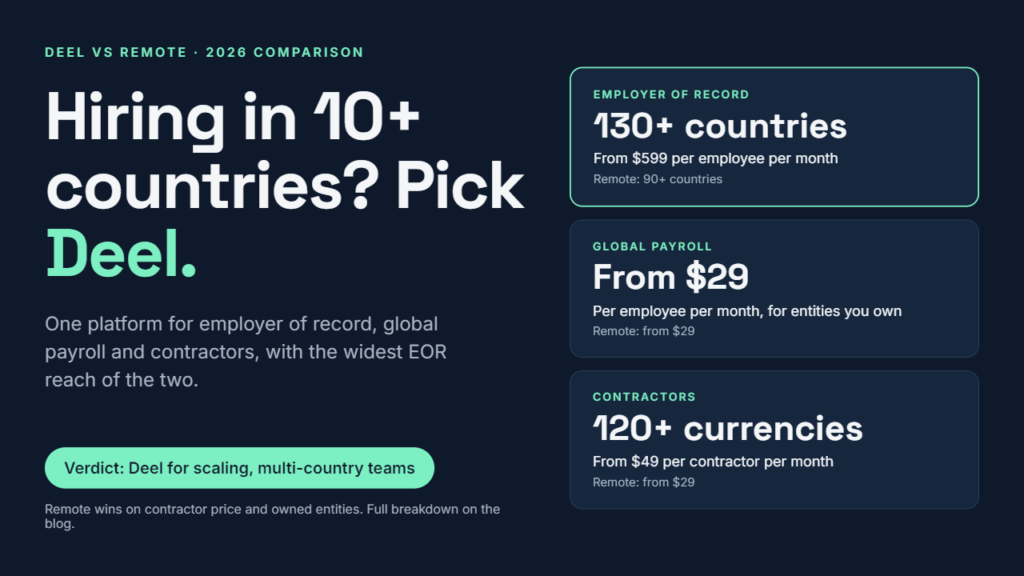
This is the gap that global employment platforms like Deel exist to close. Deel operates as the infrastructure layer underneath the hiring decision: once an AI-accelerated recruiting process identifies a candidate, Deel handles turning that candidate into a compliantly employed or engaged worker — through owned local entities, in-house compliance logic, and payroll that runs in 150+ currencies across 150+ countries, backed by a network of local employment specialists in each market.
A few specifics worth noting for teams evaluating this layer:
- Hiring anywhere, compliantly, in days rather than months — Deel’s Employer of Record and global hiring products are built specifically to remove the “we’d hire there but don’t have an entity” blocker that stalls a lot of AI-sourced hiring pipelines.
- Deel’s own AI layer is positioned around operational execution rather than candidate sourcing — approving hiring, payroll, and IT workflows, aimed at letting HR teams scale process without scaling headcount, which is a different (and complementary) use of AI than resume screening or interview automation.
- Contractor-to-employee conversion and classification support, which directly addresses the misclassification exposure that’s become one of the sharpest risks in fast-scaling global teams this year.
- Built on owned infrastructure — in-house payroll engines and legal entities in the countries it serves, rather than a patchwork of third-party local providers, which matters for consistency when regulators start asking for documentation.
The practical shape this takes in 2026: AI tools own the top of the funnel — sourcing, screening, ranking, first-pass interviewing. A compliance and payroll platform owns everything downstream of “we want to hire this person” — contracts, classification, payroll, benefits, and the audit trail regulators are increasingly asking for. Companies trying to run global hiring without that second layer are the ones showing up in 2026’s misclassification and compliance-failure stories.
What this actually means for hiring teams right now
A few concrete takeaways if you’re building or scaling a global hiring process this year:
- Audit every AI tool in your hiring stack for its high-risk classification exposure, not just the flagship ATS. Interview scoring tools, resume parsers, and candidate ranking algorithms all likely qualify under Annex III if any candidate is EU-based.
- Don’t treat vendor AI compliance as someone else’s problem. As a deployer, your company shares liability even for tools it didn’t build.
- Separate your sourcing stack from your employment stack deliberately. The best AI recruiting tool in the world doesn’t reduce your misclassification risk or your payroll complexity by a single percentage point — that requires a dedicated compliance and payroll infrastructure layer.
- Build identity and credential verification into your process explicitly. With deepfake interviews and AI-generated credentials now a documented, rising problem, “we’ll catch it in the interview” is no longer a safe assumption.
- Treat the compliance layer as a growth enabler, not overhead. The companies moving fastest into new markets in 2026 are the ones who can say yes to a great candidate in a new country without a six-month entity-setup process standing in the way.
The bottom line
AI has genuinely made the front half of hiring faster and, in some ways, better. But 2026 has made it clear that speed at the sourcing stage only translates into real business advantage if the employment side — payroll, classification, and compliance — can keep pace. That’s a different kind of infrastructure than an AI recruiting tool provides, and it’s the layer that determines whether a fast hire is also a legally sound one.
See how Deel enables global hiring – from AI-accelerated sourcing all the way through compliant employment and payroll in 150+ countries!