
AI Is Rewriting Global Hiring in 2026 – But Compliance Is the Part No One’s Automated Yet
Payroll feels like the same job repeated in every country you operate in: calculate pay, withhold the right amounts, send it on time. It isn’t. It’s a different regulatory system in every country, with its own bonus mandates, its own contribution math, and its own penalty structure for getting the timing wrong — and almost none of it is intuitive if your mental model was built running payroll in a single market.
Here’s where multi-country payroll actually breaks, what it costs when it does, and a checklist worth running against your own setup.
Statutory Bonuses Aren’t a Year-End Nicety
In roughly 28 countries, “13th-month pay” isn’t a discretionary gesture — it’s a legally mandated extra month of salary, with its own calculation formula, deadline, and penalty for missing it.

Latin America carries the largest concentration by far, covering nearly every market in the region. Southern Europe adds Portugal, Spain, Greece, Italy, and Malta. Asia-Pacific’s mandates are narrower but real — the Philippines and Indonesia require it broadly, while India applies a statutory bonus to defined categories of workers. A handful of African markets, including Angola and Côte d’Ivoire, mandate it as well.
The details compound the complexity. Indonesia’s version, THR, is religion-aware — paid before Eid al-Fitr for Muslim employees, before Christmas for Christian employees, before Nyepi for Hindu employees, and before Vesak for Buddhist employees. Colombia splits the payment into two installments, roughly half in June and half in December. Brazil requires two installments by law, due November 30 and December 20.
And here’s the trap that catches even careful employers: in countries where the payment is customary rather than statutory — Germany’s Weihnachtsgeld, common Christmas bonuses in the Netherlands and Austria — courts in many jurisdictions will still treat a long-standing voluntary payment as an established practice. Stop paying it without changing the underlying policy, and you can face a breach-of-contract claim even though no statute ever required the payment in the first place.
The Cost You Won’t See on the Offer Letter
The other place multi-country payroll quietly breaks budgets: employer statutory contributions vary enormously by country, and they’re mandatory, not negotiable.

A $100,000 hire in the US carries roughly 8% in mandatory employer contributions on top of salary. The same hire in the UK runs closer to 15%. In Germany, employer contributions to pension, health, unemployment, and long-term care insurance add roughly 21%. Brazil’s system — INSS, FGTS, and a range of additional levies — typically adds 25–35%. France sits at the top of major hiring markets, with mandatory employer contributions commonly adding 42–45% to gross salary.
Most of these contributions are capped at a wage threshold, which is easy to miss when budgeting. Germany’s pension and unemployment contributions apply only up to roughly €101,400; above that, the effective employer rate drops. The same is true for US Social Security, capped at $184,500 for 2026. A flat “add 20% for overhead” rule of thumb, applied globally, will be roughly right in one country and badly wrong in the next.
Late Isn’t a Rounding Error
The third place things go wrong is timing — and the penalties for missing a statutory remittance deadline are steeper, and more immediate, than most finance teams expect.

In the Philippines, unpaid SSS contributions accrue a 2% simple monthly penalty from the missed due date, while PhilHealth applies 3% per month, plus a possible additional surcharge for larger employers. On a modest ₱15,000 shortfall left unpaid for three months, that’s ₱1,350 in penalty alone — before addressing the underlying contribution. Miss it long enough, and Philippine law allows criminal referral for non-remittance, with real exposure for corporate officers, not just the company.
France runs a different but equally unforgiving structure: URSSAF applies a flat 5% penalty plus 0.4% daily interest on late employer contributions — which works out to roughly 12% if a payment sits unpaid for a full month. Multiply either of these across a dozen underpaid or late cycles and the penalty line item stops looking like an administrative footnote.
Both regimes share a detail worth building into your process: penalties are frequently triggered by missing a same-day cutoff time — 3 p.m. or midnight, depending on the system — not just the calendar date. A payment submitted the right day but the wrong hour can still trigger the full penalty.
A Compliance Checklist Worth Running Today
- Map statutory bonus deadlines by country, not by a single global calendar. Confirm whether each market’s 13th-month-style payment is mandatory, customary, or discretionary before you set policy — and before you consider changing it.
- Rebuild your “cost of a hire” model per country. A flat overhead assumption will misprice hiring decisions the moment you cross into a high-contribution market.
- Check contribution rates and wage caps annually. These figures move every year in most jurisdictions, and last year’s number quietly becomes wrong.
- Build remittance calendars around cutoff times, not calendar dates. Same-day submission after the cutoff is treated as late in several systems.
- Retain proof of remittance for as long as local law requires — the Philippines’ Tax Code requires 10 years of records, and retention periods vary just as much as everything else on this list.
- Reconcile local payroll monthly against a central ledger, not just at year-end, so a missed contribution surfaces in weeks, not in an audit.
Why This Gets Harder, Not Easier, as You Scale
The complexity here isn’t additive — it’s closer to multiplicative. Germany runs five separate statutory social insurance programs that each need their own calculation. Singapore runs one. Every country you add isn’t one more line item on a spreadsheet; it’s a new deadline calendar, a new contribution schedule, a new penalty regime, and, in several markets, new personal liability exposure for whoever signs off on the payroll run.
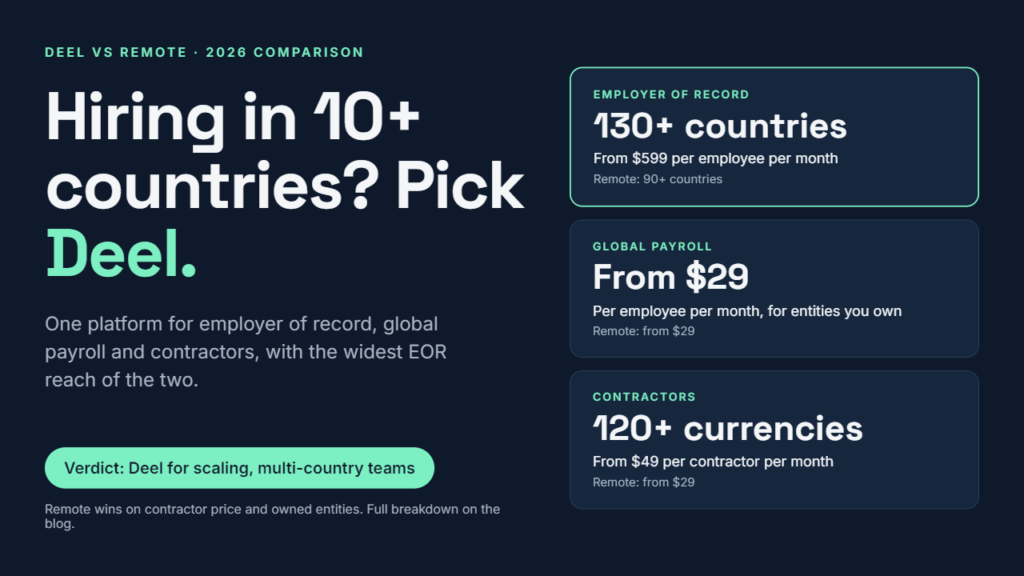
That’s the specific gap Deel’s global payroll and Employer of Record products are built to close — a single platform that calculates statutory contributions correctly by country, tracks each market’s bonus and remittance deadlines, and keeps pace when a rate or a rule changes, instead of relying on a spreadsheet someone updates when they remember to.